Enter a keyword below to search for articles and products.


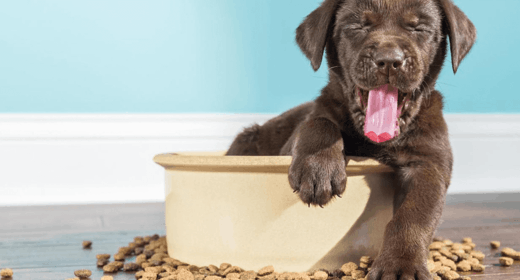
Your small- or toy-breed puppy grows rapidly in the first months of their life: Their immune system is developing, their bones are growing and their muscles are getting stronger. With all this growth, they need the right mix of nutrients to support their development. To make sure your puppy is getting the proper nutrition to protect and maintain their health and well-being, keep these key points in mind.
Research shows that puppies need up to twice as much energy as adult dogs. Because they are growing so quickly at this stage, your small-but-mighty pup needs an energy-rich, nutrient-dense small-breed dog food like IAMS™ Puppy Small Breed. Puppies also need more protein than adult dogs. High-quality animal-based protein will help your puppy create new body tissue as they grow.
Aside from protein, make sure these other important nutrients and ingredients are a part of your puppy's diet:
These are important building blocks of nutrition. Look for them when you choose dry or canned dog food and when you select treats.
When it comes to feeding puppies, one size does not fit all. Small-breed puppies have higher metabolism rates per pound and reach their mature adult weight faster than larger-breed puppies. And small-breed puppies need high levels of protein, fat, calcium and phosphorus to support the growth and development of their bones, muscles and other tissues. So, giving your puppy a food that supports their breed size is the easiest way to make sure they’re getting the right balance of nutrients for their growth rate.
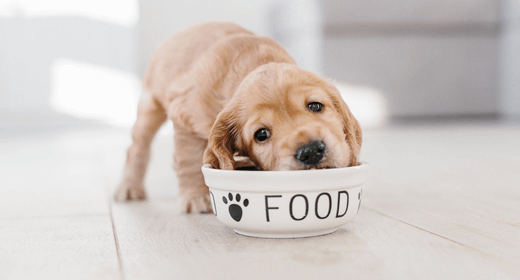
And remember: Small-breed puppies also have small mouths and stomachs! Make sure your puppy's food has small kibble for easy chewing. A nutrient-dense formula will help your puppy get a complete and balanced diet even though their stomach can only hold what seems like a small amount of food.
From the time your puppy is weaned until 4 months of age, you should feed your puppy two to three times a day. Check the food label guidelines to feed them the proper daily amount. After your puppy is 4 months old, feed them twice a day on a regular schedule. And make sure they always have access to fresh water, too!
A small-breed puppy reaches adult weight faster than larger breeds. You can start feeding an adult dog food, such as IAMS™ Adult Small Breed, when they are around 9 to 12 months old.
Your dog might not be thrilled about the change at first, but don't worry. You can help ease the transition by gradually introducing the adult food. Try mixing 25% of the new food with 75% of their puppy food, and then gradually change the proportions over the next three weeks until they are eating 100% adult food.

A product code is a series of numbers and letters printed on the outer package of each product that a manufacturer produces to provide information about when the product was made.
As part of the product code, products manufactured by The IAMS™ Company include a 'Best Used By' date, or the date at which the product is no longer considered fresh and should no longer be sold. This date is expressed in “ddmmyy” and “ddmmmyy” formats (line 1 below).
The second line represents company internal information for use in traceability and inventory control (line 2).
Depending upon the production line, pouch products might have code date information in a single or double line.
By recognizing and understanding these codes, customers can make sure they are receiving a fresh product.
Shelf life is the duration, measured in months, during which a product that is stored properly maintains its freshness. This means that if a product has a 16-month shelf life, it is fresh for up to 16 months from the date of manufacture.
The shelf life for our dry dog and cat foods is 16 months. All canned and pouch formulas have a shelf life of 24 months. Biscuits have a 12-month shelf life, and sauce formulas have a 16-month shelf life.
Unopened dry products are best stored off of the floor in a cool, dry place. Open bags of food should be stored in a clean, dry container with a tight seal. Dry products also might be frozen without loss of nutrients.
Opened wet products are best kept refrigerated in tightly sealed containers for no more than three days after the can has been opened. Wet products should not be frozen in unopened cans or pouches. However, wet foods can be frozen if removed from the container, packed in freezer containers and frozen immediately.