Enter a keyword below to search for articles and products.


Your puppy will grow the fastest during the first six months of his life, so you’ll want to take special care to plan a healthy diet from the start. “Growing puppies have a lot more energy than adult dogs,” says Madan Khare, DVM. “They require more nutrients in each bite because they can’t eat in large quantities.” Here’s everything you need to know about feeding your puppy, including what food to choose, how often to feed him and how to handle treats and teething.
Look for a premium puppy food with key ingredients such as animal-based proteins (chicken, beef or lamb) for strong bones, and energy-rich fatty acids (omega-6 and omega-3 are two) for a healthy skin and coat. When perusing the products at your grocery store, don’t be tempted by the low-cost brands in the huge bags. They may contain lower-quality ingredients and artificial preservatives and may not provide your dog the with optimal nutrition he needs.
Premium puppy food, such as IAMS™ ProActive Health™ Smart Puppy, is more easily digested and has additional nutritional value, containing nutrients such as DHA that are naturally found in milk from the puppy’s mother. Discuss with your vet and read package labels to determine an appropriate formula for your dog’s breed and size.
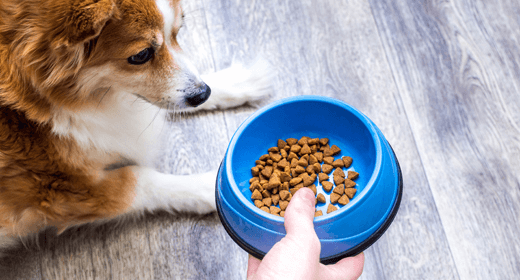
Create a clean, quiet spot for your puppy to eat, preferably in the kitchen. Additionally, provide your pup with fresh water in a clean bowl at all times, even outdoors. You may want to place a mat beneath both bowls to easily clean up spills or crumbs and keep the area tidy.
Develop a consistent eating schedule that coordinates with yours. At first, feed your puppy three times a day (consult your vet about proper quantities). After four months, twice daily should be fine.
'Feed your puppy while you eat your breakfast, lunch and dinner,' Khare suggests. Your puppy will learn that you eat at the table and he eats from his bowl. This will deter any tendency to beg. “He'll appreciate the bonding time, too,” Khare adds.
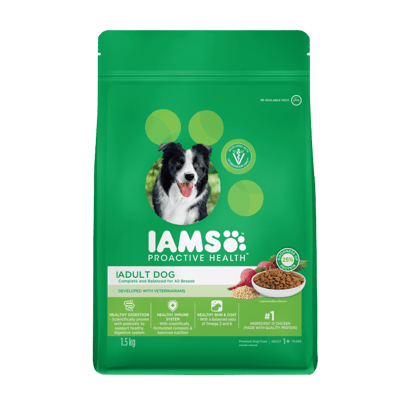
Premium dry food, such as IAMS™ ProActive Health™, is your best bet for balanced nutrition, value and convenience. When stored properly, it’ll stay fresh longer than moist food — and it requires fewer cleanups.
For a teething puppy, you may want to mix dry food into moist food.
Use vet-recommended treats when training your dog, but with moderation. Don't offer human food, though — it may do more harm than good because it won’t have the important nutrients your pet needs.




Ethoxyquin is a synthetic antioxidant (artificially manufactured from other elements) that is approved for different uses.
Ethoxyquin is approved and regulated by the Food and Drug Administration (FDA) and the Association of American Feed Control Officials (AAFCO) for use as a preservative in animal feeds.
Dog-food manufacturers have been using ethoxyquin to prevent rancidity and to maintain the nutritional quality of their products for more than 35 years.
Ethoxyquin remains stable at the high temperatures required to process dog foods during extrusion. It is important in protecting fats and oils from degrading, losing available calories, and becoming rancid.
Despite the fact that all studies conducted to date prove that ethoxyquin is safe for use in all animal foods when used at approved levels, rumors continue to circulate to the contrary.
Individuals who seek to discredit the use of ethoxyquin will often cite certain studies that showed toxic effects in animals fed ethoxyquin. What these individuals fail to point out is that the animals in these studies were given excessive amounts of ethoxyquin—20 to more than 50 times the maximum limit—before negative effects were exhibited.