Enter a keyword below to search for articles and products.


Your puppy will grow the fastest during the first six months of his life, so you’ll want to take special care to plan a healthy diet from the start. “Growing puppies have a lot more energy than adult dogs,” says Madan Khare, DVM. “They require more nutrients in each bite because they can’t eat in large quantities.” Here’s everything you need to know about feeding your puppy, including what food to choose, how often to feed him and how to handle treats and teething.
Look for a premium puppy food with key ingredients such as animal-based proteins (chicken, beef or lamb) for strong bones, and energy-rich fatty acids (omega-6 and omega-3 are two) for a healthy skin and coat. When perusing the products at your grocery store, don’t be tempted by the low-cost brands in the huge bags. They may contain lower-quality ingredients and artificial preservatives and may not provide your dog the with optimal nutrition he needs.
Premium puppy food, such as IAMS™ ProActive Health™ Smart Puppy, is more easily digested and has additional nutritional value, containing nutrients such as DHA that are naturally found in milk from the puppy’s mother. Discuss with your vet and read package labels to determine an appropriate formula for your dog’s breed and size.
Create a clean, quiet spot for your puppy to eat, preferably in the kitchen. Additionally, provide your pup with fresh water in a clean bowl at all times, even outdoors. You may want to place a mat beneath both bowls to easily clean up spills or crumbs and keep the area tidy.
Develop a consistent eating schedule that coordinates with yours. At first, feed your puppy three times a day (consult your vet about proper quantities). After four months, twice daily should be fine.
'Feed your puppy while you eat your breakfast, lunch and dinner,' Khare suggests. Your puppy will learn that you eat at the table and he eats from his bowl. This will deter any tendency to beg. “He'll appreciate the bonding time, too,” Khare adds.
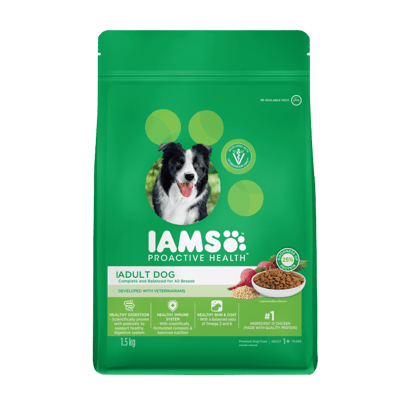
Premium dry food, such as IAMS™ ProActive Health™, is your best bet for balanced nutrition, value and convenience. When stored properly, it’ll stay fresh longer than moist food — and it requires fewer cleanups.
For a teething puppy, you may want to mix dry food into moist food.
Use vet-recommended treats when training your dog, but with moderation. Don't offer human food, though — it may do more harm than good because it won’t have the important nutrients your pet needs.




Found in the blood and in the fluid that surrounds cells, sodium maintains the cellular environment and prevents cells from swelling or dehydrating. Sodium is also important for maintaining proper nerve and muscle cell function.
Meat, poultry, fish, and eggs are good sources of sodium.
Sodium also might be included in commercial pet foods in the form of table salt (sometimes listed on the ingredient panel as salt). Salt is an important palatant for animals, as well as for people.
The Association of American Feed Control Officials recommends that dry dog foods contain at least 0.3% sodium for both maintenance and to support normal growth and development. This is the minimum recommended levels.
While high sodium intake might cause increased thirst and water consumption, the extra sodium is excreted in the urine of dogs. Healthy dogs are able to consume diets with higher sodium levels than those found in most commercial pet foods without increased blood pressure or gain in body water.
Therefore, the sodium level in commercial pet foods is not a cause for concern in healthy animals.

A veterinarian might recommend decreasing a dog's sodium intake if the animal has some types of kidney, liver, or heart disease, in order to help decrease high blood pressure or the accumulation of excessive body fluid.
Although older dogs might be more likely to develop these diseases, healthy older dogs do not require a low- or reduced-sodium diet.
The sodium level in our dog foods is appropriate for a healthy dog. The sodium content in these foods is balanced in proper proportions with energy, other minerals, vitamins, fats, proteins, and carbohydrates.