Enter a keyword below to search for articles and products.
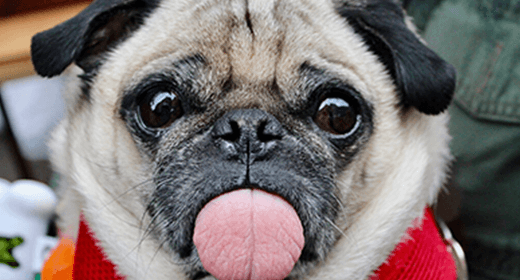
Worried that your small-breed dog is packing on the pounds? Run your hands along his backbone. You should be able to feel (but not see) his ribs. You also should see a clearly defined waist behind the ribs. If you can’t, follow these seven tips from Debra Eldredge, a veterinarian and co-author of “Dog Owner's Home Veterinary Handbook,” published by Howell Book House.
Before you put your overweight dog on a diet, schedule an appointment with the vet to make sure an underlying health problem isn’t causing the numbers on the scale to creep up.
Snacks and table scraps might account for your overweight dog’s bulging belly, Eldredge says. If curtailing in-between meals doesn’t make a difference, consider continuing with the same amount of food but switching to a different formula. Your vet can give you guidance.
Thawed frozen green beans, canned pumpkin (which is fiber-rich and filling) and cut-up carrots make satisfying, low-calorie snacks for your pet.
A study showed that dogs can count up to six or seven, Eldredge says. If he is accustomed to getting two small biscuits as a treat, break one biscuit into two pieces. By his count, he’s still getting two treats!
As much as your overweight dog loves treats, he also loves taking walks, playing and spending time with you. You also can replace biscuits with a couple of pieces of the kibble he would get during mealtime.
Is your bichon staring up at you with those beautiful eyes as you nibble on peanuts? He’s probably not hungry. As you have your snack, offer him a piece of kibble. If he turns it down, he’s not really hungry — he just wants your peanuts!
If your overweight dog has just a couple of pounds to lose, it can be hard to gauge whether he is making progress. Ask your clinic if it’s OK if you stop in once a week so he can step onto the doctor’s scale.
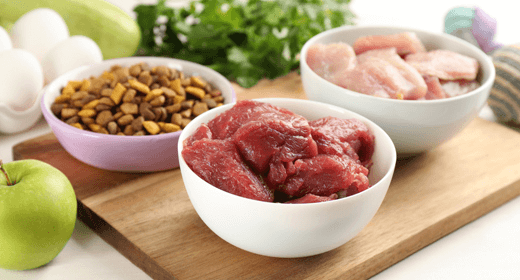
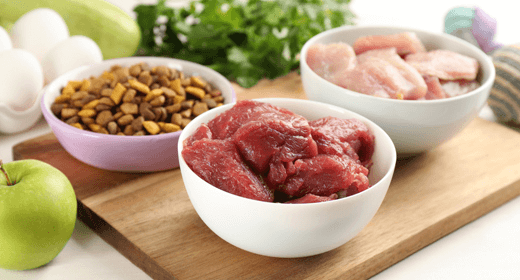
Nutrients are divided into subcategories: protein, carbohydrates, fats, vitamins and minerals, and water. Regular brushing and professional cleaning can keep your dog’s teeth healthy and gleaming. Giving your pet appropriate toys to chew prevents fractures.
Common dog food protein sources include meat, poultry, fish, and some plant ingredients, such as corn gluten and soybean meal.
Protein is best known for supplying amino acids to build hair, skin, nails, muscles, tendons, ligaments, and cartilage. It also plays a main role in hormone production.
Dogs, best fed as carnivores, require essential amino acids that are not all found in the proper balance in single plant protein sources such as soybean meal.
Common carbohydrate sources are plants and grains. Carbohydrates, also categorized as starches (sugars) and fibers, provide energy and bulk, respectively.
Starches are made up of various types of sugar, such as glucose or fructose. Through digestion, dogs can easily convert sugar into usable energy.
Fiber may or may not be fermented or broken down into short-chain fatty acids by bacteria in a dog’s intestines. Highly fermentable fiber sources, such as vegetable gums, provide high amounts of short-chain fatty acids. Moderately fermentable fibers, such as beet pulp, provide short-chain fatty acids and bulk for moving waste. Slightly fermentable fibers, such as cellulose, provide mainly bulk for moving waste through the digestive tract and only a few short-chain fatty acids.
Water is the single most important nutrient for the body. Without it, the body cannot transport nutrients, digest nutrients for energy, regulate temperature, or eliminate water.
Fats are found in meats, poultry, fish, and plant oils. Fat, for all its bad press, fulfills many vital body functions. Animal cell membranes are made of fat. Fat also helps maintain body temperature, control inflammation, and more. Fat is the primary form of stored energy in the body, providing twice as much energy as carbohydrates or proteins.
Fats also have been shown to be important in blood clotting and managing inflammation.
Vitamins are responsible for aiding functions such as bone growth, blood clotting, energy production, and oxidant protection. Vitamins A, D, E, and K require fat for absorption into the body, while vitamins such as the B-complex vitamins and vitamin C need water to be absorbed into the body.
Minerals provide skeletal support and aid in nerve transmission and muscle contractions.