Enter a keyword below to search for articles and products.


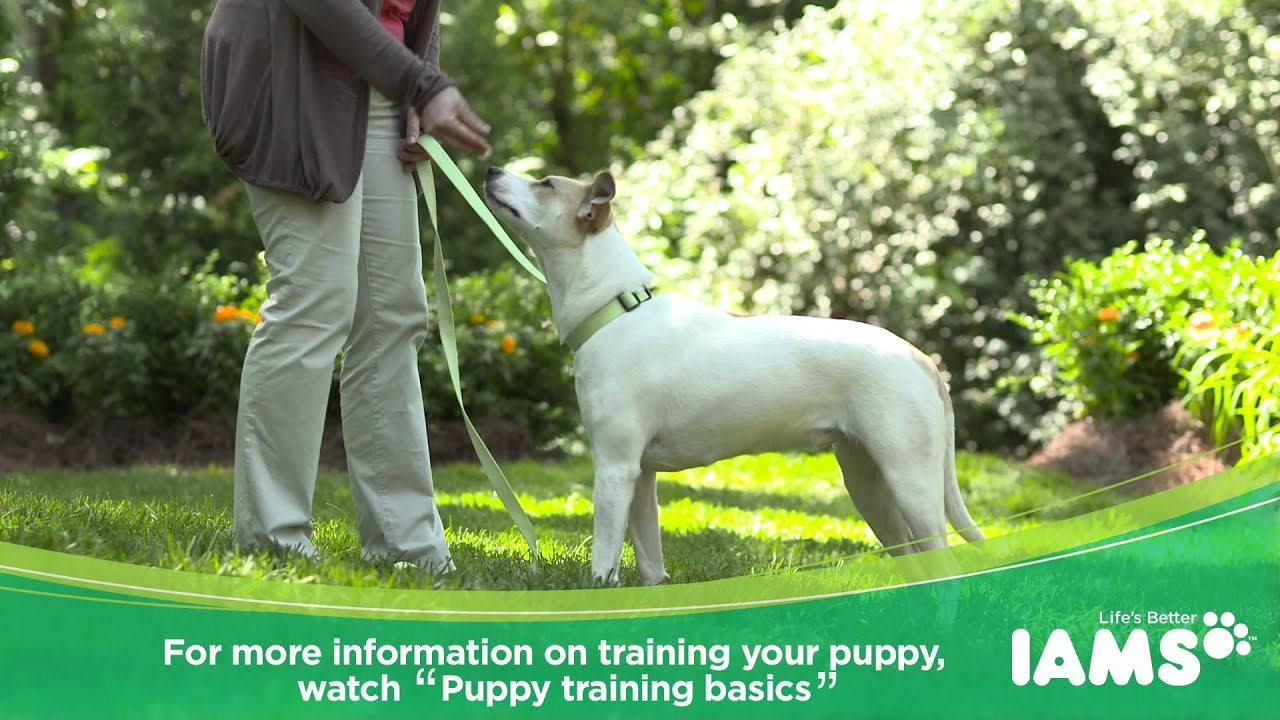
You want to take your new puppy out for a stroll; now, all you need to do is train him to walk on a leash. Watch as Expert Pet Trainer Kathy Santo show you how to walk your new family member.
Hi, I'm Kathy Santo with IAMS, and today we're going to talk about how to leash train your puppy. Once your puppy is around eight weeks old, you can begin leash training. The first thing you'll need is a collar or harness that fits your puppy appropriately, never too lose or too tight. You should be able to fit two fingers between the collar and your puppy's neck. When deciding between using a collar or a harness, there are a few things to consider. Does your puppy have any respiratory issues? Does your puppy pull when being walked on leash? Use a harness or head halter if your puppy pulls on leash, or has respiratory problems. Before you can jump right into training, you'll need to get your puppy used to wearing a collar and having the added weight of a leash. The best thing to do is have him wear the collar or harness and leash around the house, so he becomes used to the feeling. Be sure to keep an eye on your puppy to make sure he doesn't get trapped, caught, or accidentally injured. If your puppy is noticeably struggling, or looks scared, start off with a shoelace, or a small piece of rope, so he can get used to dragging only a little something around. This will help him get used to the added presence and weight of a collar and leash. Now for walking on a leash. The leash should have some slack, because when you put pressure on a dog, their natural reflex is to move or pull in the opposite direction. If you find that your puppy is afraid of walking with the leash, try placing treats along the route you know you'll be walking, to give him the notion that good times are ahead. That way, he learns to focus on what's ahead of him with curiosity, and not fear. As you begin walking your puppy, you will notice that your pace will sometimes have to be faster than you expect to retain slack in the leash. The more you work with your puppy, the quicker you'll be able to train him to slow down, while maintaining the needed slack. As you walk around, begin incorporating specific commands for your puppy. Basic commands include sit, stay, and heel, or let's go. Do your best to remain consistent with your commands, and guide your puppy through the learning process. For example, when you say sit, guide your puppy to sit until the command is recognized by the puppy. When you say heel, make sure your puppy is obeying your command before you start walking again. When your puppy starts to move ahead too quickly, come to a complete stop and wait for him to cease pulling before going forward. Practice his stop and go, never allowing your puppy to dictate your pace. If your puppy continues to pull on his leash, ask him to change directions, while saying 'turn.' This will condition your puppy to always look for you for direction, instead of him feeling like he can dictate where the two of you go next. I also like to run backward, and then switch to a different direction. This gets your puppy excited about chasing you. Remember to reward your puppy when he does the right thing, so that he begins to understand what you're asking him for. If your puppy still isn't catching on, try upgrading your treats, practicing in an area with fewer distractions, or working on more basic commands. Leash training takes time and patience. Both you and your puppy may get frustrated during the learning process. Do your best to avoid tugging. It's not fair to correct them for something they don't understand. As your dog enters adolescence, and clearly knows the difference between right and wrong, it's OK to give a slight occasional tug on his leash, if he insists on being difficult. If you remain patient and consistent with your puppy, he'll be leash trained in no time. I'm Kathy Santo with IAMS, and I hope that you found this helpful as you welcome your new addition to your family.


The Association of American Feed Control Officials (AAFCO) was formed in 1909 to establish a framework for uniform regulation of the feed industry. Although not a government agency, AAFCO operates within the guidelines of federal and state legislation including laws administered by the Food and Drug Administration (FDA) and the U.S. Department of Agriculture (USDA).
AAFCO establishes standards or models for regulations aimed at ensuring that manufacturers provide clear, accurate, and consistent information about animal feed, including pet food.
Every year AAFCO issues an official publication called the AAFCO Manual. This manual, in addition to listing ingredient definitions and feed terms, addresses labeling issues such as label format, ingredient lists, nutrition claims, and guaranteed analysis.
These model regulations are different than laws. However a large number of state governments have adopted AAFCO pet food model regulations into state law.
The “AAFCO statement of nutritional adequacy or purpose,” also called a “nutrition claim” or “complete and balanced statement,” identifies which life stage and/or lifestyle the product has been approved for. Under AAFCO regulations, this statement must be substantiated by the manufacturer.
AAFCO recognizes three methods for substantiating the claim:
AAFCO has outlined very specific protocols, or guidelines, for conducting feeding tests. The protocols specify test criteria including such things as:
Each life stage has its own protocol. Life stages are the same for both dogs and cats and are defined as:
A pet food with an 'All Life Stages' claim can be used from weaning through adulthood. This claim is considered an unqualified (absolute) representation of nutritional adequacy. If substantiated through feeding trials, the protocol for gestation/lactation and growth must be performed sequentially, using the same group of animals.
AAFCO regulations state that specific wording must be used when a diet is intended for special nutritional or dietary needs that require the involvement of a veterinarian for diagnosis, management, and follow-up.
Understanding the AAFCO statements for nutritional adequacy can help customers choose a high-quality diet that provides complete and balanced nutrition for the appropriate life stage of their dog or cat.