Enter a keyword below to search for articles and products.


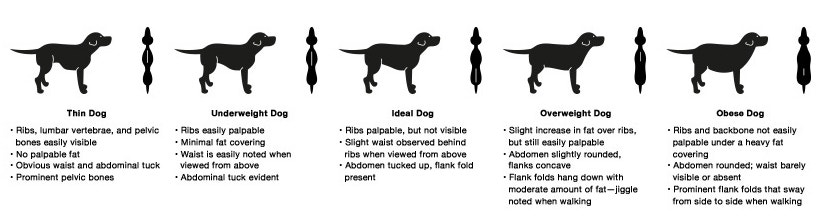
Assessing body condition is an important step in the overall evaluation of a companion animal's nutritional well-being.
Particularly in cases where the dog appears to be obese or underweight, it is important to evaluate total health of the dog before a proper nutritional management program is selected. The following body condition charts help explain body condition terms.


Good nutrition is as important to your dog’s health as it is to your own. But with thousands of different pet foods available, how do you pick the right one for your dog?
Learn how to choose a dog food that provides the proper, balanced nutrition your dog needs to thrive with these six tips.
In general, while a human diet should be high in fiber and low in fat, a dog needs more fat for energy and a healthy skin and coat, and less fiber for good intestinal health.
Preferably, a dog’s food should include meat, too. Even if you prefer a vegetarian diet, designing a high-quality dog diet without animal protein is difficult. IAMS™ Company research supports that meatless meals might not provide optimal nutrition for dogs. Dogs are best fed as carnivores because they have simple stomachs and short intestines that are ideal for digesting animal protein and animal fat. Dogs also need carbohydrates for energy.
Start by identifying your dog’s life stage and lifestyle. Puppies, nursing mothers and mature pets each represent different life stages, and each one has different nutritional requirements. By law, all dog foods must state the life stage for which they are recommended.
Nutritional needs also vary depending on lifestyle. A dog whose primary activity is guarding the couch doesn’t need as much energy as one who guards a flock of sheep. Another factor to consider is breed size: small, medium or large.
Finally, consider medical conditions your dog has, such as food allergies, that might require your veterinarian to recommend a special diet.
Once you’ve determined your dog’s life stage and lifestyle needs, decide whether to feed him dry or canned food. Most dogs do well eating only dry food. Dry foods promote oral hygiene for healthy teeth and gums through abrasive chewing action. Some dogs, especially finicky eaters, enjoy wet food because of its smooth, wet texture.
Remember that while dry food can be left in a bowl all day, wet food should be thrown away after 30 minutes if not consumed. Dry food is the best choice for busy people who are not normally home during the day.
After you determine your pet’s nutritional needs and preference, you are ready to go shopping.
Ingredients on dog-food labels are listed in descending order according to weight. Because dogs thrive on animal-based diets, it’s best to pick a food that features an animal-based protein source, such as chicken, lamb, fish or egg, as the first ingredient. Unlike a single-vegetable-based protein source, such as soybean meal or corn-gluten meal, animal-based protein sources contain adequate amounts of essential amino acids.
Scientific studies show that a combination of carbohydrates in the diet, such as corn meal or barley and grain sorghum, offers optimal carbohydrate digestibility and helps maintain energy levels. In addition, scientific studies show that beet pulp — the material remaining after sugar is extracted from sugar beets — is an excellent fiber source and promotes a healthy digestive tract. Finally, for a glossy coat and healthy skin, your pet needs fat in the diet. Good fat sources include chicken fat and fish oil.
Dog-food labels provide limited information about the nutritional value of the food because labeling regulations do not allow manufacturers to describe the quality of ingredients on the package.
A reputable pet-food manufacturer will be able to explain their specific methods for evaluating and assuring the quality of ingredients used in its products.
When choosing food, the price on the bag, while important, is usually not the best consideration. A low price might indicate inexpensive ingredients, or ingredients that change as market prices fluctuate.
Also, many lower-priced products have higher daily portions to provide the same amount of nutrition found in a high-quality diet. To get a better representation of value, it is the cost per feeding, not the total cost, that counts.
To figure cost per feeding, divide the total cost by the number of days the product lasts. For example, a 20-pound bag of food costs $18.99 and lasts 30 days. The cost to feed is $0.63 per day. A 20-pound bag of food that costs $15.99 and lasts 20 days costs $0.80 per day. So, when costs are analyzed properly, high-quality pet foods compare quite favorably to other brands while offering outstanding nutrition.