Enter a keyword below to search for articles and products.


As a veterinarian, I’ve found that pet owners take seriously the responsibility of ensuring their dogs live healthy, happy lives. They worry about making sure their dog gets enough exercise, receives regular wellness checks and receives balanced nutrition that gives them energy to run and play.
What some people don’t realize is that owning and caring a dog can improve the owner’s health as well. Spending quality time with your dog and providing them with quality nutrition is good for the dog and can help ease stress and anxiety levels for you. Studies have shown that owning a pet can decrease blood pressure, cholesterol levels and triglyceride levels — which is great news for your heart health.
In short, when your dog is getting the best care, proper exercise, nutrition and love, they can enjoy a long and healthy life. And that can ultimately make you healthier, too!
Many owners see their dog as part of the family, and that sometimes means they will feed their dog like they feed themselves. For example, some people may choose low-carb or gluten-free diets for themselves and do the same for their pets. However, while this instinct comes from a place of love, many owners don’t realize that their dog’s dietary needs differ from their own.
Take grains for example. As a veterinarian, it’s important for me to note that grains are good for your dog. Yes, you read that right — they’re good!
A very small percentage of dogs may have a food sensitivity that requires a special grain-free diet or a dog food without a certain protein. However, this is not necessary for the vast majority of dogs. Most dogs benefit from a complete, balanced diet with healthy grains, high-quality proteins and essential vitamins and minerals.
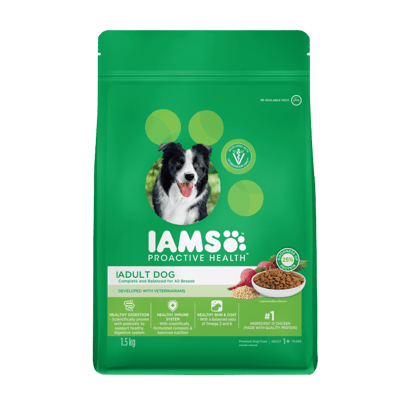
Here’s why: Grains are a good source of carbohydrates that provide healthy energy. Some grains, like rice and wheat, provide “quick” energy, while other grains, like barley and sorghum, take longer to convert to energy. A combination of these different grains can offer a time-released energy source that helps dogs sustain energy. The whole grains in IAMS dog food are a beneficial mix, as they supply steady energy.
In addition to the grains you’ll find in IAMS food, you’ll also find high-quality proteins, like chicken and lamb, as well as essential nutrients needed to help support heart health. Together, this combination will give your dog a steady source of energy to be active on walks, runs, hikes or play sessions around the house.
For your dog to be healthy and happy, be sure you feed them a well-balanced diet and allow them enough exercise time. In return, you’ll get unconditional love, plenty of sweet doggy snuggles and maybe even more exercise — just a few of the ways you and your dog are joined at the heart.



The Association of American Feed Control Officials (AAFCO) was formed in 1909 to establish a framework for uniform regulation of the feed industry. Although not a government agency, AAFCO operates within the guidelines of federal and state legislation including laws administered by the Food and Drug Administration (FDA) and the U.S. Department of Agriculture (USDA).
AAFCO establishes standards or models for regulations aimed at ensuring that manufacturers provide clear, accurate, and consistent information about animal feed, including pet food.
Every year AAFCO issues an official publication called the AAFCO Manual. This manual, in addition to listing ingredient definitions and feed terms, addresses labeling issues such as label format, ingredient lists, nutrition claims, and guaranteed analysis.
These model regulations are different than laws. However a large number of state governments have adopted AAFCO pet food model regulations into state law.
The “AAFCO statement of nutritional adequacy or purpose,” also called a “nutrition claim” or “complete and balanced statement,” identifies which life stage and/or lifestyle the product has been approved for. Under AAFCO regulations, this statement must be substantiated by the manufacturer.
AAFCO recognizes three methods for substantiating the claim:
AAFCO has outlined very specific protocols, or guidelines, for conducting feeding tests. The protocols specify test criteria including such things as:
Each life stage has its own protocol. Life stages are the same for both dogs and cats and are defined as:
A pet food with an 'All Life Stages' claim can be used from weaning through adulthood. This claim is considered an unqualified (absolute) representation of nutritional adequacy. If substantiated through feeding trials, the protocol for gestation/lactation and growth must be performed sequentially, using the same group of animals.
AAFCO regulations state that specific wording must be used when a diet is intended for special nutritional or dietary needs that require the involvement of a veterinarian for diagnosis, management, and follow-up.
Understanding the AAFCO statements for nutritional adequacy can help customers choose a high-quality diet that provides complete and balanced nutrition for the appropriate life stage of their dog or cat.