Enter a keyword below to search for articles and products.
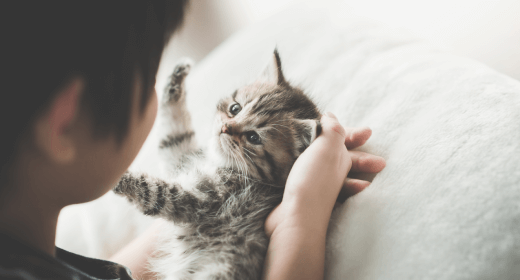
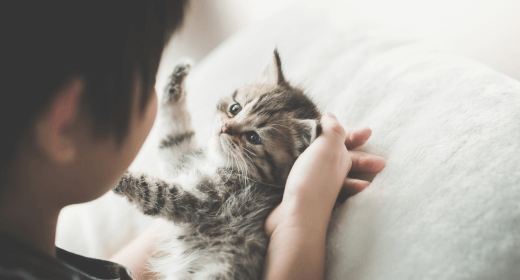
While keeping kittens indoors has significant benefits, protecting them from a large number of dangers, it does require you to pay attention to the provision of enrichment opportunities. While kittens spend a great deal of their time sleeping, their periods of wakefulness can and should be used to stimulate psychological and physical activity. The natural predatory/play behavior of kittens is usually easy to stimulate with interactive toys, such as feathers on a string or flicking a laser dot along the floor and walls. One way to defeat the “nighttime crazies” is to have a pet owner engage in active, vigorous play before feeding your kitten at bedtime. This mimics the natural hunting-feeding-grooming-sleeping sequence of cats.
Kittens also can be trained. They will respond quite favorably to clicker training using a high-quality food treat as reinforcement. As with dogs, training sequences can be used to ensure that kittens are getting adequate physical and mental exercise. Many cats also benefit from social activity with other cats, especially if they were introduced to other cats early in life. Cats put a premium on managing space, so it is important that multiple-cat homes offer a variety of places to hide, sleep, and observe, using both the horizontal and vertical dimensions.
A greater challenge is providing enrichment opportunities for dogs and cats when a person or another pet is not present to interact with them. Kittens and cats will spend a great deal of time watching out windows, especially if there is a bird feeder or butterfly garden within view, so make sure to keep at least one window blind open—especially if it looks out to an area with frequent movement and activity.
Providing your kitten with enrichment opportunities helps to prevent stress and the development of abnormal behaviors. These abnormal behaviors, in turn, put a strain on the pet owner and can play a key role in eventual relinquishment. Enrichment also provides a context for physical and psychological exercise that supports the overall well-being of your kitten.

Every cat owner recognizes the warning signs of an upset feline stomach: the mournful meow, gagging and the heaving retch. But just as suddenly as it began, your cat returns to good health while you’re left scrubbing the carpet.
The scenario is a familiar one for Cynthia Bowen of Cleveland, Ohio. As the owner of four Maine Coons, Bowen has cleaned her share of messes. “It would happen every couple of months or so,' she says. 'Otherwise, they were perfectly healthy.'
Although it's not a pleasant subject, vomiting is something cats seem to do on cue. Many cat owners accept this as a natural part of owning a pet, but it doesn’t have to be that way. Knowing what triggers an upset stomach and what you can do about it will make for a better relationship with your cat.
Many owners attribute their cat’s vomiting to hairballs, but that’s not the only culprit. “It’s careless to assume that most cases of vomiting in cats are due to hairballs,” says Dr. William Folger, a DVM from Houston. Two other frequent causes of an upset stomach are eating too fast and curiosity.
Cats sometimes eat too much too fast. When the stomach wall expands too quickly, a signal is sent to the brain to cause regurgitation. In these cases, the mess on your floor is from regurgitation, not actual vomiting. When a cat regurgitates, she brings up fluid and food from her esophagus by opening her mouth — unlike vomiting, which involves gagging and retching.
Regurgitated food is still formed and may smell fermented. “Cats that eat too quickly because they are gluttonous or stressed by food-bowl competition can regurgitate right after eating,” says Dr. Sara Stephens, a DVM from Montana. But don’t assume regurgitation is always a case of eating too quickly. It could be caused by esophageal problems, obstruction of the digestive tract, hairballs or dehydration. If you’ve forced your cat to eat slowly and she still has problems, contact a veterinarian.

Grass, carpet and toilet paper are just a few things cats may digest and later vomit. The vomiting is a protective mechanism — nature’s way of cleansing your cat’s system. Sometimes, though, curiosity can lead to more serious problems. String, toy parts and feathers are favorites of playful felines and can lodge in the stomach or intestine, causing repeated vomiting and severe distress. If your cat exhibits these symptoms, take her to a veterinarian immediately. Surgery is often necessary to remove the object.
Repeated cat vomiting should never be ignored because it can lead to dehydration. But because vomiting is common in cats, how do you know what’s normal? “A general guideline is that if the cat is vomiting one to three times a month, we consider this normal,” says Dr. Folger.
He considers it serious if the vomiting occurs twice daily for two or three days. If your cat stops eating, seems to have stomach pain or retches continuously, or if the vomit is mixed with blood, take her to a veterinarian. And as always, if you’re suspicious that a lingering problem could be harmful to your pet, call your veterinarian. A visit to the office can help relieve your cat’s discomfort and your worries as well.
Often, owners accept their pet’s vomiting as a natural part of their behavior, but just because cats seem to have more than their fair share of stomach issues doesn’t mean you don’t have options.
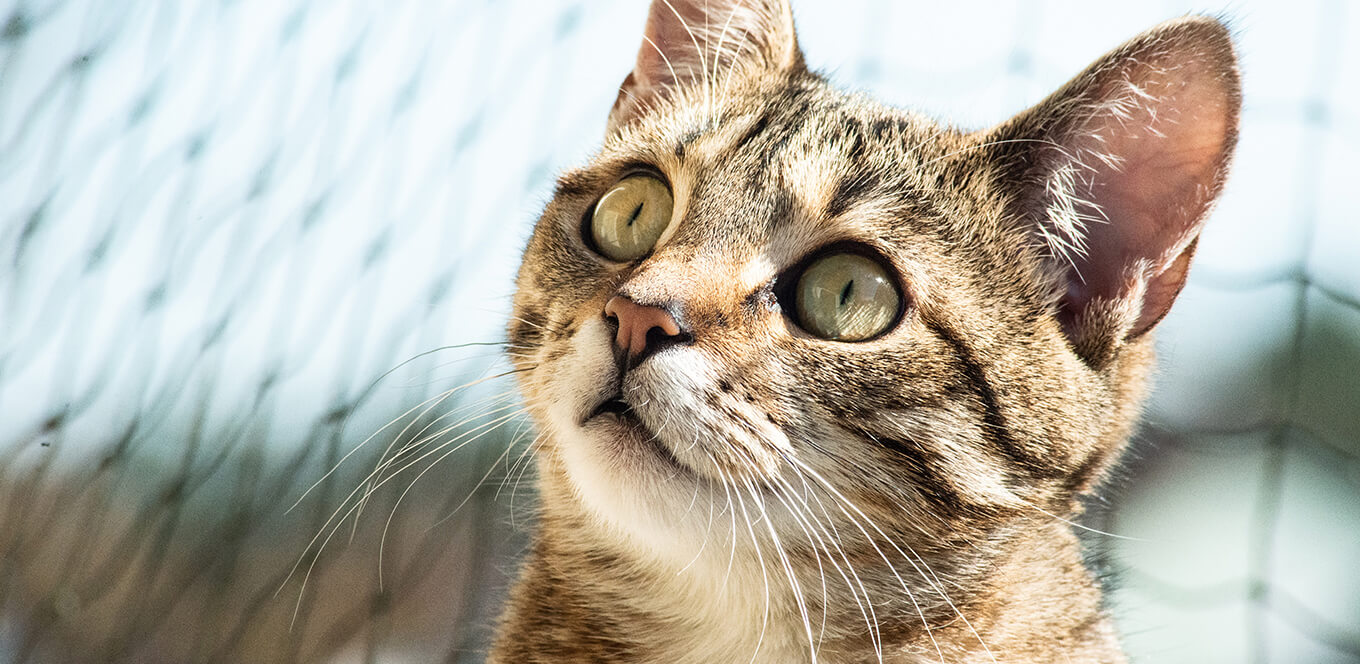
One simple preventative measure is to get your fast-eating cat to slow down or to simply eat less. Dr. Stephens recommends feeding smaller portions, elevating your cat’s food dish slightly or putting an object, such as a ball, into the dish. The cat will be forced to eat around the ball, thus slowing her intake. If you do this, make sure the ball isn’t small enough to swallow. And you may need to feed cats in a multiple-cat household at different times and places to reduce competitive eating.
If simple solutions don’t work, watch your cat’s eating behavior and reactions. Bowen, for example, tried changing her cats’ diets. “Since switching to IAMS™, they rarely throw up,” Bowen says.
“Usually, when you change to a higher-quality diet, there is no problem,” Stephens says. Here are some tips for helping make sure your cat’s food transition is as successful and comfortable as possible:
If your cat vomits more than three times a month or has chronic stomach issues, you can take several steps to help resolve her discomfort. With your veterinarian’s help and a little effort on your part, your cat’s stomach issues can be a thing of the past.