Enter a keyword below to search for articles and products.
Most of us check ingredients and nutritional information on packaging when buying food for our pets. However, reading the nutritional data on a cat food label can get confusing. So, how do you know whether your pet is getting the right food for a healthy body? In this blog, we look at what you can expect to find on a cat food nutrition label and help you improve your understanding of this information.
Cat food labels provide limited information regarding the nutritional value of the package contents. It is important for customers to know what can and cannot be determined from the label, and what information is particularly important. Major components of a pet food label include:
Guaranteed Analysis
Company/Customer Service Information/Satisfaction
Ingredient Panel
Manufacturing Code, Expiration, or 'Best Used By' Information
Feeding Instructions
AAFCO Statement of Nutritional Adequacy
Values in the guaranteed analysis are expressed as either minimum or maximum. A maximum guarantee (% max) means at most this specific amount of the nutrient is included in the formula. A minimum guarantee (% min) means at least this specific amount of the nutrient is included in the formula. The following four nutrients must be included on all pet food labels:
For example, a cat food with a 25% minimum crude protein guarantee should contain at least 25% protein but could contain much more. The only way to determine the actual amount is by laboratory analysis.
Other information may be guaranteed on cat food products, such as magnesium (% max), taurine (% min), ash (% max), and linoleic acid (% min).
Animal-feed laws, particularly those pertaining to pet food, are dealt with by AAFCO. AAFCO is a coalition of governmental organisations in North America that aids in regulating animal food. Cat food with AAFCO label has an assurance that certain standards have been followed while manufacturing the food. Therefore, the food is said to meet the nutritional levels required by your pet. MARS pet food too complies with the standards of AAFCO and is nutritionally sound for your pet.
Ingredients must be listed in order of abundance (largest quantity listed first).
Because ingredient definitions and designations are standardized, it is difficult to determine the quality of ingredients. Ingredient quality can only be determined from laboratory analysis and animal feeding tests.
Here is the information that is required on a cat food label:
Distributor Name and Address: This gives you information about the manufacturer of the food, so that you can get in touch with them if you have any issues about the product.
Net Weight: This tells you how much food is contained in the package.
Ingredient List: The ingredients are listed in decreasing order, depending on the weight of the contents.
Product Traceability: Using the information on cat food label, you can identify when the food was prepared and even the precise factory that made the package.
Statement of Nutritional Adequacy: A ‘complete and balanced’ cat food should either meet or exceed the defined standards of nutrient profile. It explains which exact cat age and lifestyle the food is meant for.
Assurance of Analysis: This indicates the product’s nutritional content. It must contain the highest amounts of crude fiber and moisture and the minimum amounts of crude protein and crude fat. Although optional, percentages for other nutrients are frequently included. However, the key elements mentioned in the assured analysis of the cat food nutrition label must meet AAFCO’s nutrient profile guidelines.
Calorie Declaration: Calories are stated on a kilocalorie per kilogram basis and other commonly used units of measurement such as kilocalories per cup. You can compare several cat food products using this information.
Direction for Feeding: You can use these recommendations to figure out how much food to give your cat each day. Additionally, you might need to change the amount of food your pet consumes to assist them in maintaining an ideal body condition.
AAFCO nutritional adequacy statements are required on all pet foods. Products may either be formulated or tested according to AAFCO procedures and recommendations.
A 'tested' statement indicates the product has been formulated, then fed to cats prior to sale to ensure it meets important criteria related to growth, maintenance, and/or reproduction.
Veterinary-exclusive products include statements such as, 'This product is intended for intermittent feeding only' and 'Use only as directed by your veterinarian.'
Manufacturing codes allow the company to track products for quality and inventory issues. In order to quickly and efficiently handle a customer inquiry, the company's customer service department will usually ask the customer for this code.
Expiration or 'Best Used By' dates are optional but are helpful in determining product freshness and shelf life.
Here are a few tips to help you read a cat food nutrition label.
Know the intent or purpose: The food must state that it is for cats on the container. Cats have highly specific nutritional requirements that necessitate a certain type of diet.
Choose the right product for your cat: The information on the back of the cat food container is extremely important. You can determine whether the food will offer a complete and balanced diet for your cat’s life stage by reading the nutritional adequacy statement. The term 'life stage' describes a cat's particular stage of growth. The information can also state that the food is suitable for cats at all life stages, for breeding cats (growth and reproduction), and, possibly, for indoor or outdoor cats.
The manufacturer's information should include the company name, address, and phone number so customers can quickly and easily obtain product information.
A toll-free telephone number should be provided as a convenience to the customer and to ensure that a charge is not incurred when calling for information.
The satisfaction guarantee should be an 'active' statement. This means that in addition to stating that the product is guaranteed, the company should indicate what action will be taken to meet customer expectations (replace product, money returned, etc.).
According to AAFCO guidelines, cat food should have a minimum of 26% protein content on a dry matter basis. This portion is typically regarded as complete and nutritionally balanced.
The difference between +1 and +7 cat food is the high fiber content in +7 cat diets. Despite having the same proportions of protein, fat, and minerals as adult cat diets (+1), senior cat foods (+7) have fewer calories than food for cats aged 1+ years.
Details about the quality of food ingredients are not required on a cat feed tag.
Yes. The production of cat and dog food as well as other dog treats or snacks are all regulated by the FDA.
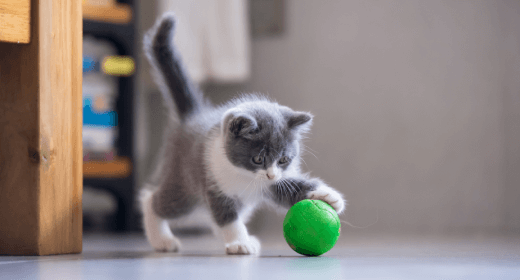
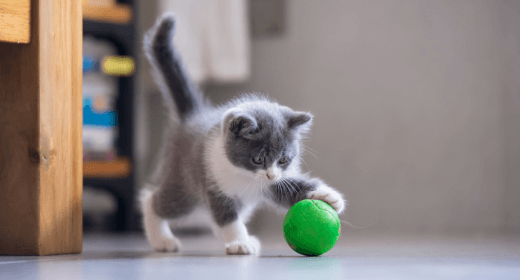
Your kitten is one of a kind, not to mention adorable. But training your li’l baby comes with some basic guidelines. Scroll on for a handful of our favorite kitten training tips.
Introduce your new kitten to their litter box as soon as they get home. Then always set your cat in their box right after meals and as soon as they wake up from naps.
And don’t forget to reward your kitten with a treat, toy or some extra love after they use it.
Kitty, meet litter.
Litter, meet kitty.
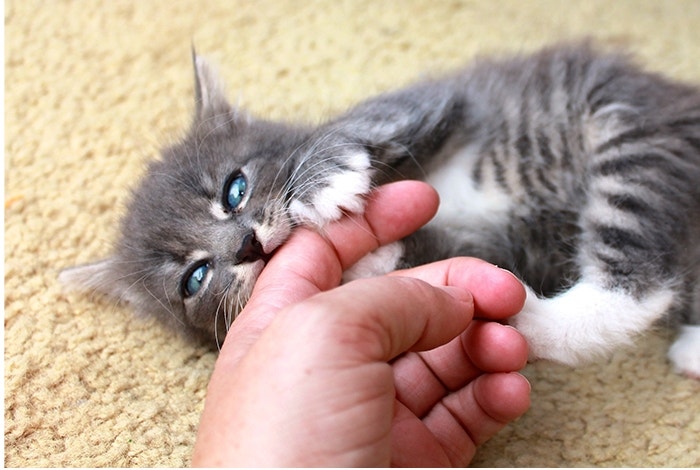
When Kitty forgets their manners and bites you or shows their aggressive side, say “ow” or “no” clearly and sternly.
Then slowly remove your hand — or other body part — from their razor-sharp clutches. Pick up your kitten, place them away from you, walk away and ignore them.
You can also redirect them to a feather wand or another toy or activity if you want. But that’s your call.
Ouch!
That’s my hand,
not a treat, tiny cat.
By giving your little feline lots of sturdy scratching posts throughout your house, especially where they like to hang out, you can save your favorite furniture from unwanted claw marks and damage.
Oh, and be sure to trim your kitten’s nails regularly.
Say it with me:
Sofas are NOT
scratching posts.
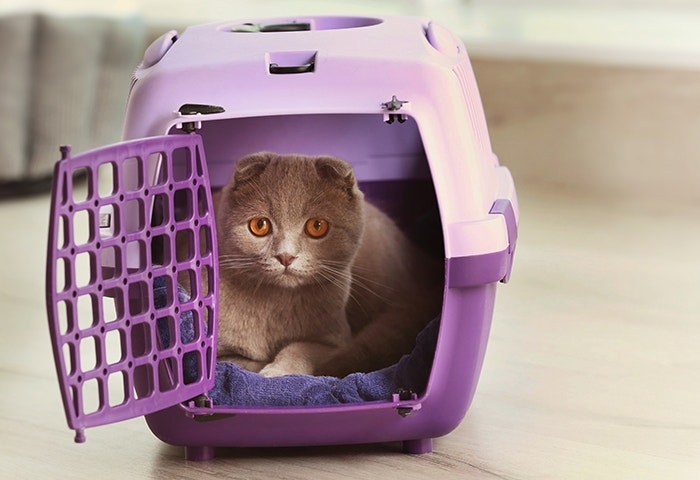
Teach your kitten that their cat carrier is a safe, comfortable place to chillax and feel protected.
Trust us, by making a carrier part of your fuzzball’s daily life, road trips and vet visits will be easier and safer for years to come.
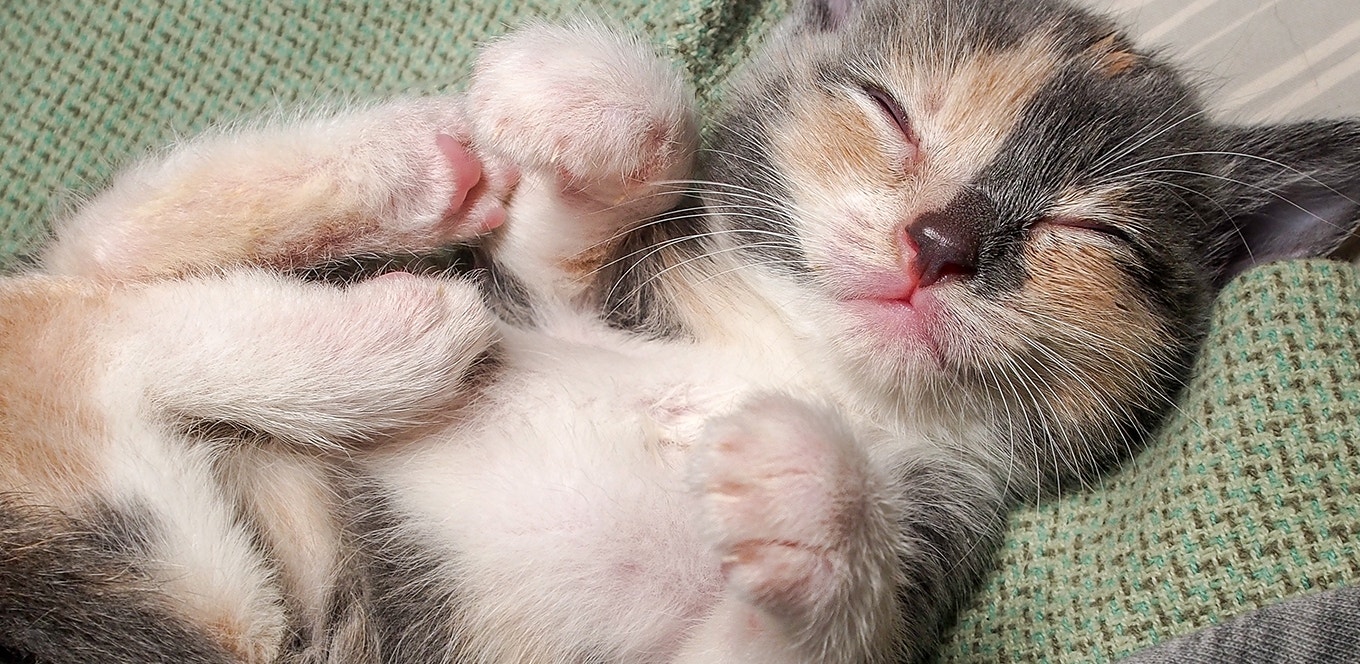
Cozy up,
Buttercup.
It's midnight. Bring on the zoomies, furry one.
(Actually, please don’t.)
Want to stop your kitten from bouncing off the walls while you’re supposed to be deep in slumber land? Try these tips.
Have a long play session later in the evening.
Feed your feline a big meal of delicious, nutritious Opens a new windowIAMS™ Healthy Kitten or PERFECT PORTIONS™
Spend 15 minutes of purr-worthy snuggle time before you hit the hay.
Yep, it’s true! One of our favorite Opens a new windowstudies from the University of South Australia proved it.
To help train your kitten, pick the word that best describes them:
These anxious felines tend to run away when the doorbell rings and are fearful of new situations.
The key to training a skittish kitty? Practice lots of patience and never force them to face their fears, like meeting your house guests after they’ve already runaway and hidden.
Some call them nosy, but we call them fearless. Outgoing kitties are curious and adventurous. They love to explore and get into everything — and they sometimes act naughty because they’re bored.
One of the tricks to training an outgoing kitten is to give them lots of toys and actively play with them. It stimulates their mind and helps burn off energy.
“Bossy” best describes these kitties. They bully other cats (and even other pets) and hog things like food bowls, toys and litter boxes.
If your kitten fits this category, be consistently firm and make sure you play with them regularly so they have less energy to be aggressive.
You might also want to make sure your little CEO (Cat Executive Officer) has their own food bowl, water bowl and litter box.
Two words describe these felines: impulsive and erratic. Their behavior and moods are unpredictable, even if they’ve encountered the same situation before.
When training, never raise your voice — it’ll just ramp up your kitty’s nerves and make them more erratic.
Also, be sure to stick to a consistent daily schedule for feeding and playtime so your little fuzzball knows what to expect and doesn’t get stressed out.
This personality is every cat lover’s dream.
These sweeties can usually be found curling up against your shins, meowing loudly and purring away.
The key to training these kittens is to never yell and to socialize them early and often. That way, they’ll continue to be everyone’s best friend for life.
You had me at
meow, li’l feline.